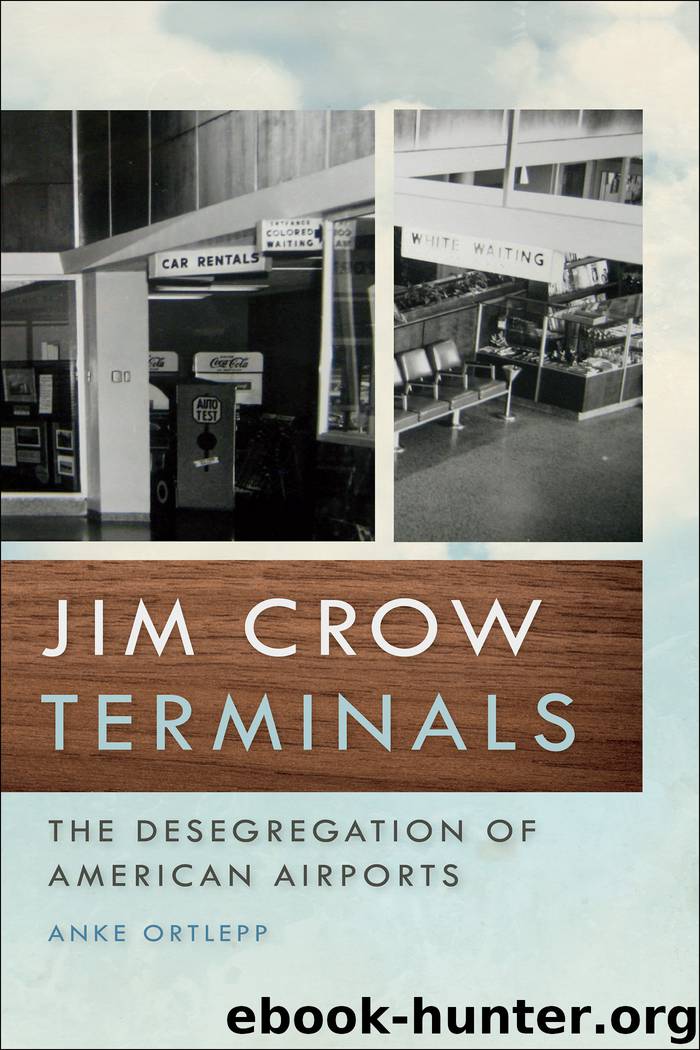
Jim Crow Terminals by Anke Ortlepp
Author:Anke Ortlepp
Language: eng
Format: epub
Publisher: University of Georgia Press
Published: 2017-04-19T04:00:00+00:00
CHAPTER 6
Back in the Courts
Federal Antisegregation Lawsuits
Government activities on integration involved not only the FAA and Congress but also the Department of Justice. Besides assisting the FAA with legal advice in changing the agency’s policy regulations, the Justice Department also played a role itself in the struggle for integration of airports. In part it was responding to outside pressure, which reached crisis levels during the Freedom Rides in 1961. At the same time, the Justice Department’s activities—in particular those of the Civil Rights Division—were a reflection of its changing responsibilities. They also reflected the growing conviction of officials, such as Attorney General Robert F. Kennedy, that the administration had to become more involved in abolishing segregated travel facilities.1 As important as the FAA’s regulatory reforms and Congress’s legislative initiatives were, they left in place racially exclusive spatial regimes that were maintained by local airport authorities. As Robert Dixon has pointed out, the reforms had no effect on the practices of Jim Crow at existing terminal facilities—constructed with or without federal funds—or at terminal buildings to be constructed in the future with local funds.2
To challenge these Jim Crow practices, the Department of Justice recognized that federal lawsuits against airport authorities were an effective tool. In selecting airports to press charges against, it closely cooperated with the FAA, which could and did request action from the Justice Department. By the early 1960s, aviation’s built environment was in the process of changing. A number of airports by then had integrated voluntarily (like Nashville and Knoxville) in reaction to persuasive efforts by local civil rights groups or representatives of the Civil Rights Division; others, like Tampa, had refrained from building segregated facilities with grant money provided by the FAAP.3 In a number of other cities, individual private lawsuits against airport authorities had either brought victories for the plaintiffs (e.g., Coke v. Atlanta) or proceedings were pending. Jackson was about to be forced into compliance with federal regulations by FAA pressure. This left a number of cities where local authorities were so immune to calls for change from local activists, the FAA, and other antisegregation forces that the Department of Justice initiated legal action against them in 1961 and 1962. These cities—including Montgomery, Birmingham, New Orleans, and Shreveport—can be considered as bastions of airport segregation.4
The substantive federal standards on which these lawsuits rested were established in the 1960 Boynton v. Virginia case. In Boynton, the Supreme Court upheld an interstate carrier’s obligation to make terminal facilities available to all passengers on a nondiscriminatory basis, even if those facilities were operated by a lessee. The Court construed these services to include lunch counters and restaurants, thereby overriding state regulation of these facilities.5 In light of this interpretation, which applied to bus transportation regulated by the Motor Carrier Act, segregated airport terminal facilities also seemed illegal. The Federal Aviation Act, after all, included nondiscriminatory language similar to provisions in the Motor Carrier Act. Lacking the power to enforce the Fourteenth Amendment beyond voting rights, the Justice Department
Download
This site does not store any files on its server. We only index and link to content provided by other sites. Please contact the content providers to delete copyright contents if any and email us, we'll remove relevant links or contents immediately.
Whiskies Galore by Ian Buxton(42078)
Introduction to Aircraft Design (Cambridge Aerospace Series) by John P. Fielding(33175)
Small Unmanned Fixed-wing Aircraft Design by Andrew J. Keane Andras Sobester James P. Scanlan & András Sóbester & James P. Scanlan(32835)
Aircraft Design of WWII: A Sketchbook by Lockheed Aircraft Corporation(32330)
Craft Beer for the Homebrewer by Michael Agnew(18285)
Turbulence by E. J. Noyes(8112)
The Complete Stick Figure Physics Tutorials by Allen Sarah(7422)
The Institute by Stephen King(7088)
The Thirst by Nesbo Jo(7002)
Kaplan MCAT General Chemistry Review by Kaplan(6988)
Bad Blood by John Carreyrou(6669)
Modelling of Convective Heat and Mass Transfer in Rotating Flows by Igor V. Shevchuk(6495)
Weapons of Math Destruction by Cathy O'Neil(6362)
Learning SQL by Alan Beaulieu(6344)
Man-made Catastrophes and Risk Information Concealment by Dmitry Chernov & Didier Sornette(6138)
Permanent Record by Edward Snowden(5890)
Digital Minimalism by Cal Newport;(5835)
Life 3.0: Being Human in the Age of Artificial Intelligence by Tegmark Max(5617)
iGen by Jean M. Twenge(5454)
